
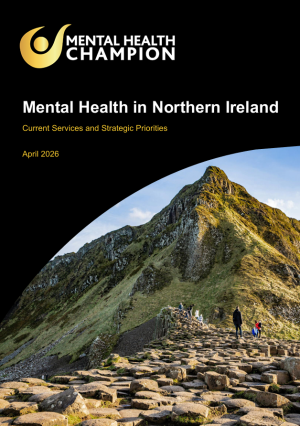
The Mental Health Champion today launches a new report ‘Mental Health in Northern Ireland: Current Services and Strategic Priorities’.
The report is a comprehensive review into mental health in NI, it includes up to date facts and figures, and sets out the implications for our people, services and policies across the life course.
The report highlights both the scale of mental health need in Northern Ireland and chronic underinvestment in services. Northern Ireland spends just £212 per person on mental health each year, the lowest in the UK and well below England’s £264.
This level of funding is out of step with demand: 18% of adults reported probable mental ill-health in 2024/25, alongside evidence of greater illness complexity and disability than in other UK regions, and significant associated economic costs.
There is a Mental Health Strategy to transforming services, but meaningful change will depend on sustained funding, political stability, better data, and the widespread adoption of trauma‑informed practice. These conditions are essential to reduce rates of mental ill‑health and to ensure timely access to services for those who need them.
To date, the report shows that service delivery has been undermined by underinvestment: in the first three years, the Mental Health Strategy received only 16% of the funding required, equivalent to just 1% of the planned 10‑year budget. Falling far short of the funding plan’s expectations, which assumed higher year‑on‑year investment to support rapid expansion of the workforce and services.
The report demonstrations the role of trauma and social inequality in driving mental ill‑health and makes the case for a cross‑departmental response to reduce both human suffering and the wider economic burden, noting that the Department of Health provides only 35% of funding for community and voluntary mental health services.
The report also emphasises prevention and the importance of action beyond health services, including trauma‑informed practice, social and emotional learning in schools, and tackling Northern Ireland’s persistently high levels of poverty.
Speaking about her hopes for the report, the Mental Health Champion, Professor Siobhan O’Neill said:
This report lays bare the state of mental health in Northern Ireland to its fullest extent. Tying together the ongoing impact of our traumatic history, rising levels of distress, the underfunding of mental health services, and the failure to adequately implement successive policies.
I am struck by the progress we have made, and the challenges that still remain. My report offers an updated view of mental health services and support across our communities, drawing together evidence to help leaders and stakeholders understand what we most need to address going forward.
The evidence is clear: whilst mental illness results from the accumulation of trauma and adversities across the lifespan, early adversity is particularly damaging. The early environment is critical in shaping emotional regulation and the risk of illness. Pressures are mounting, especially for children and young people, who experience significant distress, and too often struggle to access compassionate support. Adults too continue to feel the weight of adversity, economic uncertainty, and trauma. Women and girls, neurodivergent people, and marginalised groups encounter discrimination and barriers to care.
Yet, there is much to acknowledge. The increasing role of people with lived experience in shaping services, the dedication of mental health workers, as well as the wider commitment to trauma informed practice, and early intervention, all offer hope. Still, the need for mental health services and supports outstrips capacity, and inequalities persist.
Looking ahead, our priorities must be clear: invest in early intervention and prevention, advocate for sustainable and longer-term funding, build a stable, highly trained workforce, and ensure compassionate, timely mental health services and support for people who are struggling. Above all, we must continue to listen to those with lived experience and keep their voices at the heart of reform.
I encourage everyone to use this report as a tool for action. Together, through sustained commitment and collaboration, we can reduce the suffering and create a mental health service that truly serves those in need in Northern Ireland.
You can read the full report here: Mental Health in Northern Ireland: Current Services and Strategic Priorities